
When buyers want to judge film faced plywood quality, they often think they need a lab report first. In reality, experienced contractors, importers, and factory inspectors usually begin with a few fast on-site checks.
These simple checks cannot replace formal testing, but they are very useful for identifying obvious quality differences before placing an order. If you know what to look for, you can quickly tell whether a board is likely to be low grade, standard grade, or high grade.
In this article, we will explain five simple ways to judge film faced plywood quality like a professional. These methods are practical, easy to use, and especially helpful when comparing products from different suppliers.
If you want to understand the product itself first, you can also visit our ➡Film Faced Plywood page or browse our full ➡Products range.
Why Film Faced Plywood Quality Matters
Film faced plywood is widely used for concrete formwork, shuttering, and construction projects. Good quality boards usually offer better strength, cleaner concrete surfaces, better water resistance, and more reuses. Poor quality boards may look acceptable at first, but they can fail early, swell, delaminate, or break during use.
That is why it is important to understand film faced plywood quality before buying. According to ➡APA plywood resources, panel grade and intended use are key factors when selecting plywood for demanding applications.
1. Check the Board Edge First
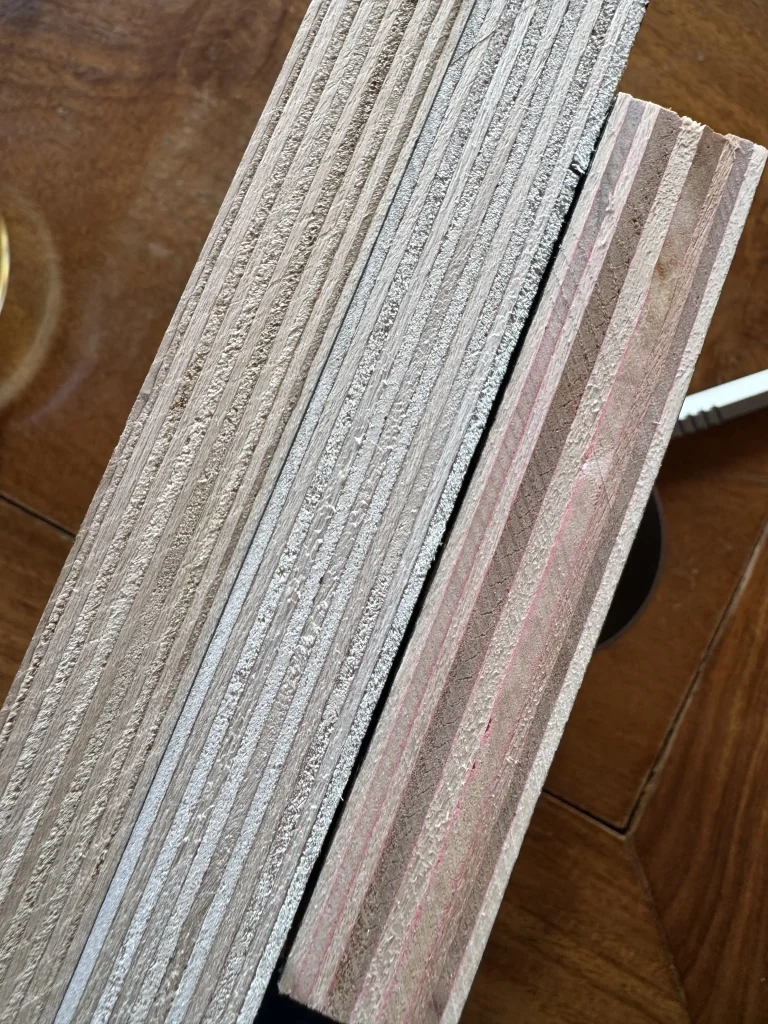
The board edge is often the fastest place to judge film faced plywood quality.
Look at the layer structure
A better board usually has a more balanced and even veneer structure. When you look at the edge, the layers should appear relatively uniform and neatly pressed together.
For 18 mm film faced plywood, more layers often mean a more refined structure. However, the real point is not only the number of layers, but also whether the veneers are consistent and well assembled.
Check for gaps and voids
When examining the edge, watch carefully for:
- large core gaps
- overlapping veneers
- broken core patches
- loose joints
- visible holes inside the board
If you can easily see internal voids from the edge, the panel may have weak areas. This often means lower strength and fewer reuses.
Look at the core consistency
The edge can also show whether the supplier used consistent core material. If the internal veneers look mixed, damaged, or irregular, the board may not perform evenly during construction use.
If you want to compare core options and product details, you can also read our guide on ➡How to Find a Reliable Film-Faced Plywood Supplier.
2. Inspect the Film Surface Carefully
The second fast check is the film surface. A good surface does not prove everything, but it still tells you a lot about production quality.
A good film surface should look:
- smooth
- flat
- evenly laminated
- free from bubbles
- free from wrinkles
- free from obvious scratches or cracks
If the film looks thin, rough, uneven, or poorly bonded, moisture may enter more easily during use. That can reduce durability and shorten the board’s service life.
Do not judge only by appearance
Some low-grade boards also look good at first glance. That is why surface inspection should always be combined with edge inspection, weight checking, and bonding observation.
A clean black or brown film is a good sign, but it should never be the only reason to judge film faced plywood quality.
3. Check the Weight — Heavier Is Not Always Better
Many buyers assume a heavier panel must be better. In practice, this is not always true.
For poplar film faced plywood, our real production experience shows that around 27 kg for an 18 mm full-size board is generally a reasonable weight. If the board is much heavier than 27 kg, it often means pine or other mixed species have been added. That does not automatically mean the quality is better.
In some cases, an overly heavy board may simply have:
- mixed hardwood or pine inside
- higher moisture content
- unbalanced density
- a structure that is heavier but not necessarily more durable
What weight can help you judge
Weight can help you estimate whether the board feels too light or unusually heavy compared with the claimed specification. It can also help identify whether different batches are consistent.
What weight cannot prove
Weight alone cannot prove:
- glue quality
- internal bonding strength
- void ratio
- actual reuse times
So when judging film faced plywood quality, weight is useful, but it should never be used alone.
You can compare product specifications on our ➡Film Faced Plywood page for a clearer reference.
4. Tap the Board and Observe the Core Response
This is a very practical check used by many experienced buyers.
Listen to the sound
When you tap the board lightly, a compact and well-bonded panel usually sounds more solid. If some areas sound hollow, that may indicate internal voids or poor core construction.
A consistent sound across the panel is usually a better sign than a board with obvious differences from one area to another.
Inspect a cut section if possible
If you can see a cut piece or sample edge, check whether:
- veneers are tightly bonded
- veneer thickness looks relatively even
- core gaps are limited
- repaired areas are properly handled
This type of inspection is simple, but it can help you screen suppliers before loading or shipment.
5. Check Bonding and Water Resistance Clues
Bonding quality is one of the most important factors in film faced plywood quality.
Film faced plywood is often used in wet and demanding environments. If the glue bonding is poor, the board may fail even when the surface still looks acceptable.
Common signs of poor bonding
Watch for these warning signs:
- open glue lines on the edge
- local separation at corners
- swelling after limited moisture exposure
- peeling film near the edge
- delamination between veneer layers
These signs usually indicate weak bonding or poor pressing control.
Why bonding matters
Strong bonding helps the panel remain stable under repeated use. Buyers should always ask about glue type, pressing process, and intended application. If the boards are supplied to regulated construction markets, it is also useful to review relevant compliance requirements such as the ➡EU Construction Products Regulation.
The Best Way to Judge Film Faced Plywood Quality
The most reliable method is not to focus on just one detail. Professionals usually combine several observations together.
A practical routine is:
- check the edge
- inspect the film surface
- compare the weight
- tap the board
- observe bonding clues
This combined method is much more reliable than judging only by appearance or only by price.
Common Mistakes Buyers Make
Only looking at the surface
A smooth film surface can hide poor core construction inside the board.
Assuming heavier means better
For poplar film faced plywood, weight above a reasonable level often means mixed species, not automatically better performance.
Ignoring the board edge
The edge often reveals more about actual film faced plywood quality than the face.
Paying attention only to price
Low prices often mean compromises in core material, glue, film weight, or pressing quality.
Not asking about the intended use
A board suitable for a short reuse cycle may not be suitable for heavy-duty formwork.
How to Choose a Better Supplier
Understanding how to judge film faced plywood quality is important, but choosing the right supplier matters just as much.
A reliable supplier should clearly explain:
- core type
- glue type
- film specification
- thickness tolerance
- expected reuse level
- packing method
- loading details
For a more detailed sourcing guide, read our article on ➡How to Find a Reliable Film-Faced Plywood Supplier. You can also browse our full ➡Products page to see more panel options.
Conclusion
To judge film faced plywood quality quickly, you do not need to start with complicated testing. In many cases, five simple professional checks are enough to identify major quality differences.
Check the edge, inspect the film surface, compare the weight, tap the board, and look for bonding clues. These simple steps can help you avoid poor-quality panels and make better purchasing decisions.
If you are sourcing plywood for formwork or wholesale business, learning these checks will save time, reduce risk, and help you compare suppliers more confidently.
To learn more, visit our ➡Film Faced Plywood page or explore all ➡Products.
FAQ
How can I judge film faced plywood quality quickly?
You can start with five simple checks: board edge, film surface, weight, tapping response, and bonding condition.
Is heavier film faced plywood always better?
No. Heavier does not always mean better. For poplar film faced plywood, excessive weight often means mixed species such as pine, rather than better quality.
Why is the board edge so important?
The edge often reveals the internal structure, including veneer layers, core gaps, and consistency.
Does a smooth film surface guarantee high quality?
No. A smooth surface is helpful, but it does not guarantee strong internal construction or good glue bonding.
Where can I learn more about film faced plywood?
You can visit our ➡Film Faced Plywood page and our guide on ➡How to Find a Reliable Film-Faced Plywood Supplier.
Recent Comments